UNLOCKING TAMPA BAY
with Bryan Burns
The last time I sat in a rowing shell was the spring of 1999.
I was the two seat on the novice men’s eight at the University of Miami, wrapping up my freshman season with a trip to the Big East Championships in Georgetown, Washington, D.C.—a city I already knew well from growing up an hour away in West Virginia. I’d spent countless weekends there as a teenager, wandering M Street and soaking in the energy of the place. Seeing it from the middle of the Potomac River was something else entirely.
It remains one of the coolest sporting experiences of my life. We rowed beneath the iconic Key Bridge, the infamous Watergate complex looming off to the side, the city unfolding around us as we charged toward the finish.
In our preliminary heat, we came in third, a solid finish but well behind Georgetown and Syracuse, which dropped us into the petite final. That turned out to be a blessing. We put together, by far, our best race of the season. Everything clicked. We flew past Virginia Tech, West Virginia, Pittsburgh, and Boston College on our way to a first-place finish.
Midway through that race, I remember a moment when the boat just…settled. Perfectly balanced. No drag. No wasted movement. Every stroke sent us surging forward instead of fighting water. We weren’t forcing anything. We were absolutely gliding through the water. It was a feeling we’d only touched briefly before, but this time it carried us all the way across the line. In our post-race huddle, we talked about how rare that feeling was, how magical it felt, and how anyone returning the next year should remember that sensation and chase it.
It was the last time I would race.
I have fond memories of my crew experience. Still, I’m not sure that if you dropped me back into that same situation today, as a brand-new freshman, I’d sign up so quickly.
I walked away from crew tougher, with great memories, and no real desire to do it again. Which is what made it feel especially ironic that, on a winter morning over two decades later, I found myself standing on the dock at the Bob Buckhorn River Center with a few of my colleagues from Visit Tampa Bay.
The Tampa Athletic Club had recently become a partner of Visit Tampa Bay and invited our team to take part in one of their corporate learn-to-row, team-building exercises. Six of us from the office showed up that morning—five complete novices and one former rower who hadn’t touched an oar this century.
Founded 16 years ago by a small group of like-minded rowing enthusiasts, Tampa Athletic Club has grown into one of the most welcoming adult rowing communities in the region. What began as a shared passion for the Olympic sport of rowing has evolved into a thriving club with 95 active rowers and a fleet of 23 shells.
The club operates out of the award-winning boathouse at the Bob Buckhorn River Center, a facility that is the envy of rowing clubs around the country. All are welcome at Tampa Athletic Club, from beginners who have never touched an oar to experienced rowers returning to the sport after years away. In just a few hours, participants can learn the basics of being in a crew through individualized coaching in small groups with no prior experience required.
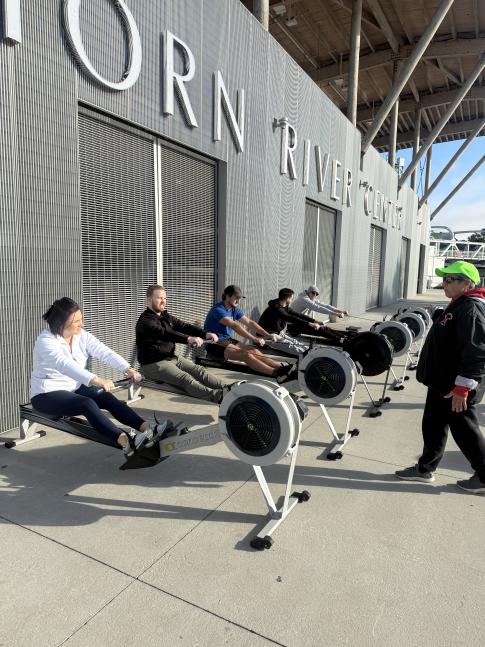
The outing spans about three hours and includes an introduction to rowing, instruction on the ergometer (the rowing machine rowers love to hate), and time on the water in a shell, plus a healthy dose of team building along the way.
By Florida standards, the morning of our rowing experience was chilly. Temps were in the low 50s, so we layered up: sweatshirts, joggers, beanies. Halfway through our “gentle” warm-up on the ergs, I’d already ditched the beanie and peeled off my sweatshirt.
The erg is the nemesis of every rower. I was once told it’s the best full body workout--better than running, better than cycling, better than elliptical, etc.—because you use your legs, core, back, and arms, all working in one fluid motion.
That may be true. It’s also relentless.
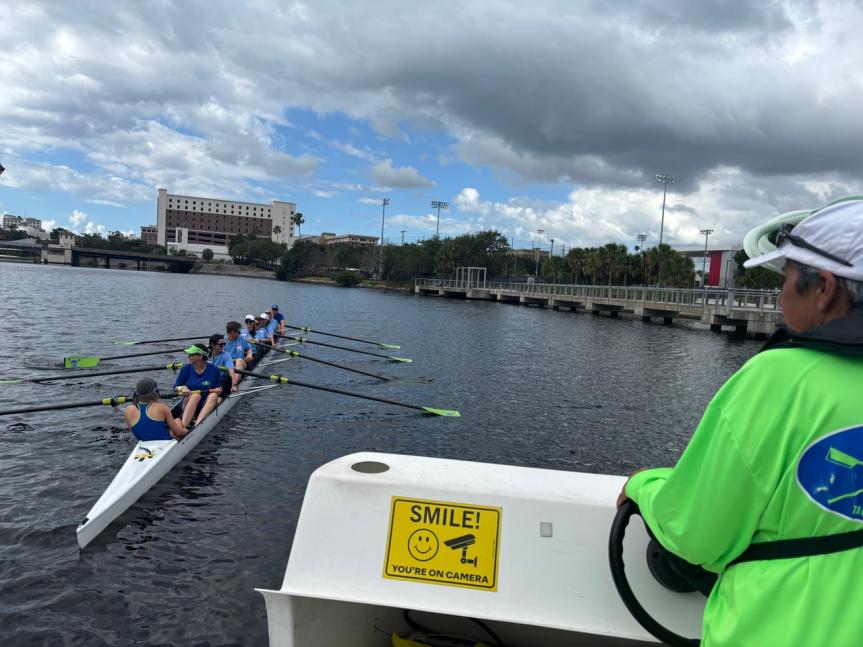
From the crouched starting position, you push with your legs, swing back through the torso, then pull the handle to your chest with your arms.
And then you do that about a million more times.
I hate the erg for the same reason I hate treadmills: you do all that work and go absolutely nowhere.
In college, we had to complete 2,000-meter erg tests under a qualifying time. If you made it, great, now do another one, immediately, and beat your time from your first test. If you managed to do so, you were finished. If you didn’t? You kept doing 2,000-meter pieces until you did.
Thankfully, our erg session at the Tampa Athletic Club was far less traumatic, more about getting a feel for the correct body positioning while rowing and learning that a controlled stroke is more desirable than just trying to go as fast as possible. We didn’t complete any 2,000-meter pieces, but it wasn’t a casual warmup easing us into the morning either.
As we lined up to get our boat off the rack and carry it down to the dock, I’ll admit I was skeptical about how this was going to go. It takes time to learn how to row, especially in a shell. If the boat isn’t balanced, it’s not fun for anyone. In college, we started by tying two boats together with a platform between them where our coach would stand, completely removing the balance element. And we did that for at least a month before we finally took the training wheels off. Here, we had a group of novices with about 45 minutes of verbal instruction and some erg work who were about to head out onto the Hillsborough River.
I didn’t see it going well.
Once you carry the boat down to the water, you get a look at your equipment. Your oar is placed in the rigger at your seat—a bar that screw locks after your oar is set keeps it in place. There are shoes already in your seat, so ideally you go barefoot (or with socks if you don’t mind them getting wet—I personally can’t stand that feeling) and slip your feet into the boat shoes once you sit down. Your seat slides on a track, in the same way the erg seat slides back and forth. When you start rowing, you’re moving backward from where you sit. You can’t see where you’re going, only where you’ve been. The coxswain sits at the bow facing toward the rowers and the direction the boat is headed, so he or she steers. The cox also acts as the captain of the ship. They tell which rowers to row, which ones to stop when you’re warming up or getting in position for a race. They coax you through the race when you’re feeling fatigued. They’ll let you know if you’re about to pass another boat and to give a power 10 so you can move through them. A power 10 is 10 hard strokes of maximum effort to really get moving. Think of it like a sprint. It’s usually accompanied by another power 10 immediately after (and maybe even a third if you still haven’t moved through the boat you’re trying to pass). The coxswain wears a headset with a microphone and is heard through a small speaker next to each seat.
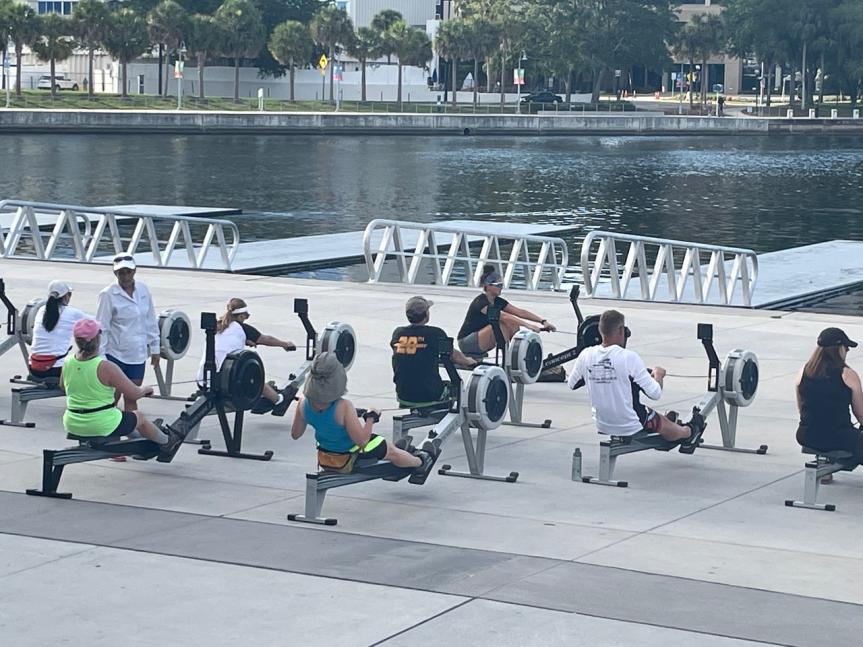
For our introductory class, our coxswain doesn’t say too much. She’s more there to make sure we don’t hit another boat on the Hillsborough. Rosanna is our coach and barks instructions into a megaphone from a launch (a low-wake or wakeless motorboat that follows alongside us).
On the water, one of the first things we did was count off our seats from bow to stern, eight through one, so we’d know our number. The coach can then say, “I need one and two to row while everybody else sits tight,” or “Eight and six, give me three hard strokes so we can move away from those rocks.” Simple enough…in theory. Except Ben, who should’ve said seven, confidently said five. The instructor laughed and decided to call him “Five” for the rest of the lesson. Unfortunately, I was the actual five, so I never quite knew if she was talking to me or Ben the rest of the lesson.
We started out rowing in pairs so everyone could get the feel of the blade and the timing. The motion is the same as it was on the erg.
Forward to ready.
Catch
Legs push.
Swing back.
Arms pull.
Again.
Forward to ready.
Catch
Legs push.
Lean back.
Arms pull.
Again.
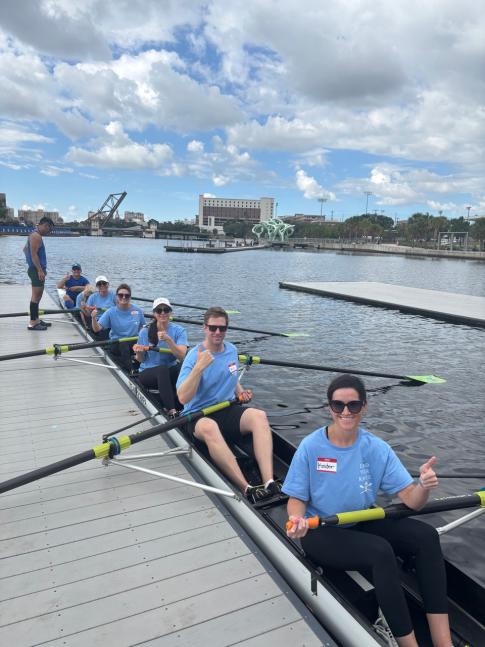
The key is to watch the person in front of you and mirror their movements. The stroke seat—number eight—sets the pace. Everyone follows them. Ideally, all eight oars enter and exit the water at the same time. Still bodies. Smooth hands. No sudden movements.
Most of the time we rowed in fours, which helped keep the boat stable while the others rested with their blades flat on the water. The four practice rowing in tandem. It’s a bit wonky at times. Your natural instinct is to watch the blade in front of you on your side. I’m a starboard, which means the blade is to my left and my right hand is on the end of the oar feathering the blade (rotating the oar handle at the finish of the stroke to turn the blade from vertical to horizontal, preventing the blade from contacting the water inadvertently as you get back to catch position). The blade in front of me on my starboard side is actually two seats ahead of me. Sitting directly in front of me is a port rower (blade to their right side). So if the starboard I’m following is not in sync with the stroke in front of them, it means we’re not all rowing at the same time and the boat isn’t settled (and we’re not moving as fast as we could be).
Rowing on the Hillsborough River is such a great way to spend the morning—the downtown skyscrapers on one side with all of the buzz and electricity that comes from a city, the University of Tampa on the other, it’s unmistakable Plant Hall with the Moorish minarets and domes commanding your attention. Rolling past apartment buildings, construction on new towers, hotels alive with patrons enjoying the pool and the surroundings, auto traffic overhead as you cross under a bridge, it’s an unparalleled perspective to see Tampa from its waterways. It makes you appreciate where we live even more.
As we passed underneath the Kennedy Boulevard Bridge, Rosanna decided to turn us loose.
“Okay, now let’s go all eight. Follow the stroke.”
The first few strokes were wobbly. The boat rocked as it searched for balance. And then—almost unexpectedly—it settled. Not perfectly, but enough. We were moving. Cleanly. We’re zipping down the Hillsborough at a pretty good clip. It felt fast. We’re not ready to enter a regatta anytime soon, but we’re not getting left in the dust if we do either.
I closed my eyes for a brief moment, and suddenly I was 19 again, rowing on the Potomac. I hadn’t realized how much I missed that feeling until this moment. Now I’m thinking, ‘I should do this more often.’
We turned around near the Tampa Convention Center and headed back upriver, the boat surging beneath us, the cooler air off the water invigorating everyone. The sound of oars and slides moving together. The downtown scenery as a backdrop. It delights all of the senses. It’s the kind of morning that stays with you.
Back at the dock, Rosanna smiled.
“I’m not just saying this because you’re here in front of me,” she said. “You all actually did really well.”
And she was right. Everyone was buzzing. People who never imagined themselves rowing had just done it. Successfully. Nobody fell in the river, which I suspect was a legitimate concern for at least a few participants.
To cap it off, the team from the Tampa Athletic Club presented us with medals to commemorate the experience.
If you’ve never visited the Bob Buckhorn River Center, or explored Julian B. Lane Riverfront Park since its transformation into a 25-acre urban playground, you owe it to yourself to check it out. And while you’re there, head down to The Boathouse on the ground floor of the River Center and book an experience with the Tampa Athletic Club.
You might just find your rhythm on the river.